Temporary Deck Removal for Moving Your Trailer or Park Model
Need to move a park model or trailer but your deck’s in the way? Learn how we safely remove, store, and reinstall decks and platforms for seasonal trailers.
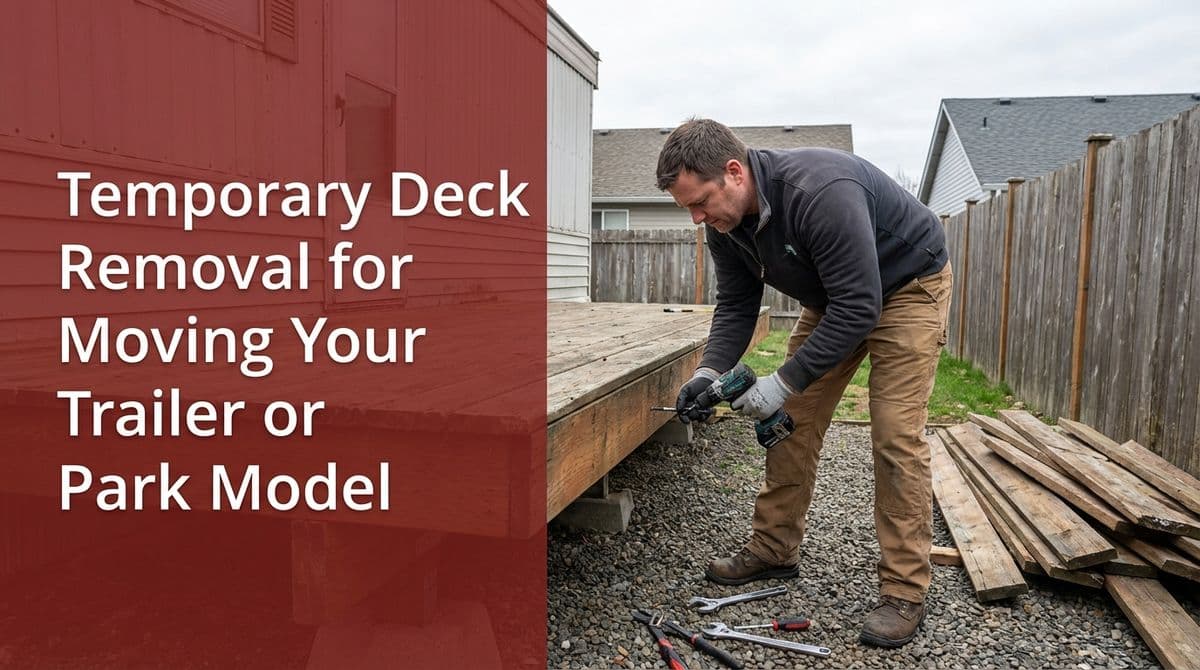
Moving a Park Model or Trailer Without Losing Your Deck
We recently got a call from a customer — let’s call him Mark — who has a destination trailer parked at a seasonal spot near a golf course. Over the years, he’d added a nice setup: a 12' x 16' main deck off the front, a 5' x 15' catwalk along the side, and a couple of smaller 8' x 8' “table decks” for seating and grilling.
Then trouble hit. The trailer developed water damage and needed to be pulled out during the winter for repairs. The problem? All that decking wrapped around it. Mark’s question for us was simple: “Can you temporarily remove the deck so they can pull the trailer out, and then reinstall it when it comes back?”
We handle this kind of project pretty regularly, so we walked him through how we’d approach it and what homeowners should think about before anyone starts unbolting boards. If you’re in a similar situation with a park model, destination trailer, or seasonal camper, here’s how we recommend tackling a temporary deck or platform removal.
Step 1: Evaluate How the Deck Is Built
The first thing we asked Mark was how his deck was connected. In his case, the sections were lag-bolted together and built as semi-modular pieces, which is ideal for temporary removal.
Before any work starts, we always look at:
- Connection to the trailer: Is the deck freestanding or attached to the trailer structure?
- Footings and support: Are there posts in the ground, concrete piers, blocks, or skids?
- Framing layout: Are there separate platforms (like Mark’s 8' x 8' sections) or one continuous structure?
- Fasteners: Are the sections bolted, screwed, or nailed together?
A freestanding deck that’s lag-bolted into sections can usually be broken down and moved with far less labor and disruption than a deck that’s fully framed as one piece and heavily tied into the trailer.
Step 2: Plan Clearances for Trailer Removal
With Mark, the goal was to get the trailer out and back in without rebuilding the deck from scratch. That means planning for the path the trailer will take in and out of the site.
When we look at a site, we walk it with a few questions in mind:
- What’s the turning radius and path for the tow vehicle and trailer?
- How much side clearance does the trailer need on both sides?
- Is there overhead clearance (trees, roof overhangs, shade structures, railings)?
- Can some deck sections stay in place if they don’t interfere with the move?
Sometimes we can simply slide or pivot deck sections a few feet out of the way. Other times, we need to fully dismantle and stack them. The more modular your deck is, the more options we have.
Step 3: Label, Photograph, and Disassemble Carefully
Mark mentioned that he’d had the main deck moved years ago by someone else, but that contractor wasn’t available anymore. That’s where documentation becomes critical — we want the reinstallation to be as close to the original fit as possible.
When we take a deck apart for a temporary move, we like to:
- Take photos from all angles before touching anything.
- Label each section (e.g., “Front A,” “Front B,” “Side Catwalk,” “8x8 North”).
- Bag and label hardware — all lag bolts and screws from each section in separate bags.
- Mark post and footing locations with paint or stakes so we can realign everything later.
Then we start loosening lag bolts and fasteners in a controlled order so that sections stay stable until we’re ready to lift and move them. For decks Mark’s size, this usually takes a small crew to move each platform safely without twisting or cracking the framing.
Step 4: Store Deck Sections Safely During the Repair
Because Mark’s trailer was going out for winter repairs, we also had to think about where and how those deck sections would sit for a few months.
To protect your deck while the trailer is gone, we recommend:
- Elevating sections off the ground with blocks or scrap lumber to keep them out of standing water and snowmelt.
- Keeping them relatively level so boards don’t warp badly.
- Stacking smaller platforms neatly with spacers between if needed.
- Covering selectively (if at all) — breathable coverage is better than trapping moisture under a plastic tarp.
In many seasonal parks, we can stage the sections on the same lot. In tighter parks or resort-style settings, we may need approval from management for a specific storage spot.
Step 5: Reinstalling the Deck When the Trailer Returns
Once Mark’s destination trailer comes back from repair, the real payoff of careful planning shows up. Because we documented and labeled everything, putting it back together should be straightforward.
On reinstall, we typically:
- Confirm the trailer is set correctly — final position, level, and height.
- Reset posts and footings based on our previous marks and photos.
- Adjust framing slightly if the new trailer has minor differences from the old setup.
- Re-bolt the sections using fresh hardware where needed for strength.
- Check stairs, railings, and guards for comfort and safety.
This is also a good time to inspect and maintain the deck — replace soft boards, tighten connections, and refresh any compromised areas, especially if you’re already dealing with water damage on the trailer itself.
When You Should Call a Pro
Some handy owners can tackle a simple, small platform on their own. But for setups like Mark’s — multiple platforms, catwalks, and a trailer that has to come in and out on a tight schedule — bringing in a crew is usually worth it.
We suggest hiring a professional if:
- The deck wraps around more than one side of the trailer.
- The framing is complex or tied into roofs, railings, or skirting.
- You’re not sure how the deck is supported or attached.
- You’re working in winter conditions, snow, or tight campground spaces.
If you’re planning to move a trailer or park model and need your deck or platform temporarily removed and reinstalled, we’re happy to take a look, talk through options, and give you an estimate so you can schedule everything before the new season starts.